
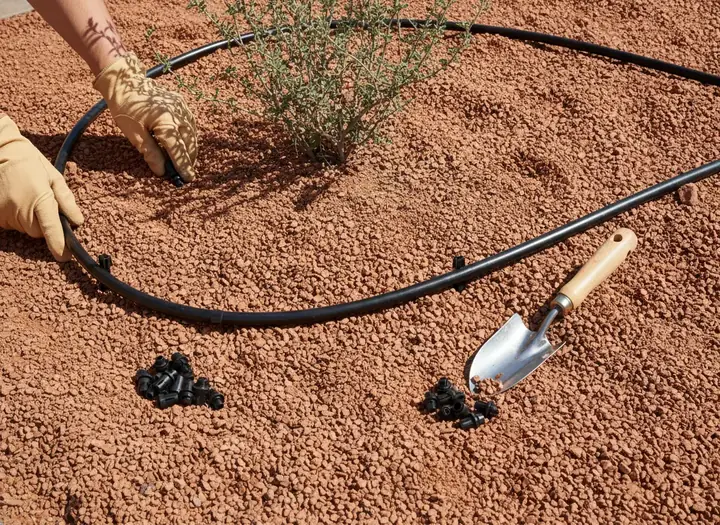
Tucson Water has no mandatory watering days or hours, so you can water any day at any time. What the City does enforce is its Water Waste Ordinance: runoff into the street, ponding, broken sprinkler heads or drip emitters and unfixed leaks can bring a warning and then a fine of at least $250 (City of Tucson). On the rebate side, single-family Tucson Water customers can get up to $1,900 for rainwater harvesting (up to $1,999 with "Treebates") and a gray water rebate, while the Turf Removal Rebate is limited to commercial, multifamily and HOA properties.
Here is how the drought plan works today, what counts as water waste, which rebates a homeowner can actually use, and how to water a desert yard well when nobody hands you a schedule.
Does Tucson have watering days or restrictions?
No. The City's drought plan page says Tucson is currently in Tier 2 of its Drought Preparedness & Response Plan (Tucson Water drought page). At Tier 2, customers who keep going over their use guidelines are required to do water audits, and the Mayor and Council may consider a drought surcharge. Outdoor watering restrictions are only an option the Council may consider at Tier 3. So there are no assigned days, no banned hours and no address-based schedule in effect.
The bigger picture is the Colorado River. The Bureau of Reclamation set a Tier 1 shortage for 2026 on the Lower Basin, which cuts Arizona's supply by about 512,000 acre-feet, mostly from Central Arizona Project agriculture (Reclamation 24-Month Study). Tucson Water's director has said the City keeps its full CAP allotment until a Tier 3 shortage (KJZZ). That is why Tucson homes have not seen watering-day rules, but it is also why the City pushes rainwater, gray water and low-water landscapes.
What the Water Waste Ordinance prohibits
The ordinance is the rule most likely to touch your yard. Under the City's page and ordinance text (ordinance PDF), these are prohibited:
- Letting water run off your property onto a neighbor's lot, an alley or a street.
- Ponding in a street or parking lot deeper than ¼ inch or larger than 150 square feet.
- Running an irrigation system with a broken head or emitter, or one that sprays more than 10% onto pavement.
- Failing to fix a controllable leak, such as a broken sprinkler head or a leaking valve.
The first violation brings a warning. After that comes a citation with a minimum $250 fine, higher for repeats. Landscape contractors and property managers can be cited along with the owner. In practice, a split drip line or a popped emitter that runs onto the sidewalk every morning is exactly what gets reported, so fix a broken emitter before it becomes a citation. Our irrigation and drip repair guide explains what that work involves.
Tucson Water rebates a homeowner can use
Funding for these programs is limited and amounts change, so confirm the current terms on the City's rebate page before you buy anything.
| Program | Who it's for | Amount (as published) |
|---|---|---|
| Rainwater Harvesting Rebate | Residential customers | Up to $1,900 (reduced from $2,000 in July 2026) |
| "Treebates" (with rainwater rebate) | Residential customers | $50 for the first and $49 for the second drought-tolerant tree; $1,999 maximum in total |
| Low-income rainwater grants and loans | Income-qualified households | Grants up to $1,000 or $750; 0% loans up to $2,000 |
| Gray water system rebate | Residential customers | Half the qualifying cost, up to $1,000 (check current amount) |
| Turf Removal Rebate | Commercial, multifamily and HOA only | $2.50 per sq ft of ornamental turf removed |
Rainwater harvesting
The rebate pays $1.00 per gallon of storage if the system is sized to hold 1 inch of rain from your roof, or $0.50 per gallon otherwise (Rainwater Harvesting Rebate). You must take a Watershed Management Group workshop before applying. Income-qualified households can apply for grants of up to $1,000 (at or below 100% of the federal poverty level) or $750 (100–200%), plus 0% loans up to $2,000 (grants and loans). With about 52% of Tucson's 10.61 inches of yearly rain falling from July through September (NOAA 1991–2020 normals), a cistern or basins set up before the monsoon catch the most water.
Gray water
The gray water rebate covers half of qualifying costs up to $1,000, and a workshop is required first (Gray Water System Rebate). Check the current amount before you plan around it.
Turf removal: not for single-family homes
The Turf Removal Rebate is often mentioned online, but it is for commercial, multifamily and HOA customers only, not single-family houses (Turf Removal Rebate). If your HOA maintains grass in common areas, it may qualify. Separately, a 2023 City code amendment bans ornamental turf in new commercial, industrial, institutional and residential common areas; single-family yards are not covered (City of Tucson). If you are weighing grass against turf at home, see artificial turf vs grass in Tucson.
Outside Tucson Water's area
Much of the metro is served by other utilities, so check with your water provider (Oro Valley Water, Marana Water, Metro Water, and others) for its rules and any rebates. Oro Valley's town code bans water waste, including runoff and leaks left unrepaired three weeks after notice (Oro Valley Town Code).
How to water well without a schedule
No assigned days means the schedule is up to you, and the University of Arizona's guidance is consistent: water deeply and less often.
- Desert trees: wet the soil to 24–36 inches every 14–21 days in summer (Tucson Clean & Beautiful). Water mature trees out to the edge of the canopy, not at the trunk (UA Extension AZ1298).
- New trees: every 2–3 days through the first summer, then stretch the interval.
- Bermuda lawns in summer: deep and infrequent, about every 3 days, rather than several short runs a day (UA Extension AZ1817).
- Winter ryegrass: about ½ to 1½ inches a week. See winter overseeding in Tucson.
- Caliche: if water pools in a planting basin for hours, a cemented caliche layer may be holding it up; UA's AZ1281 says water should drop at least 4 inches in 4 hours (UA Extension AZ1281).
Run each zone while you walk the yard once a month. Look for wet pavement, geysers, dry plants on a line that should be wet, and puddles that sit. Those are the same problems the ordinance targets.
Getting help
Published cost guides put a drip or sprinkler repair visit around $100–$299 in Tucson.
| Service | Typical range |
|---|---|
| Irrigation / drip repair | $100–$299 (average about $186; $50 to $800 at the extremes) |
| Weekly lawn / yard maintenance, per visit | $53–$158 (average about $106) |
Typical ranges from published cost guides (2026) — estimates, not quotes. See all landscaping & lawn care prices in Tucson.
Tucson Lawn Care Pros connects Tucson-area homeowners with independent local landscaping, lawn care, irrigation and tree companies for free, no-obligation quotes. The company you choose quotes, contracts and does the work directly with you. Installing a new irrigation system or a landscape job of $1,000 or more should be done by an Arizona ROC-licensed contractor, typically one holding an R-21/CR-21 Hardscaping & Irrigation Systems license; ask for the ROC number and verify it at roc.az.gov. For ongoing upkeep, see desert landscape maintenance, or request a free quote.
This is general information, not legal advice.