
If you own a home on 10 acres or less where the house is already built, Arizona's native plant law generally lets you remove protected plants such as palo verde, mesquite, ironwood and even saguaro without notifying the state. That comes from A.R.S. §3-904(H). What the exemption does not cover is moving a protected plant off your property or selling it: that requires an Arizona Department of Agriculture permit and tags. Check with the Arizona Department of Agriculture before moving or selling any native plant. This is general information, not legal advice.
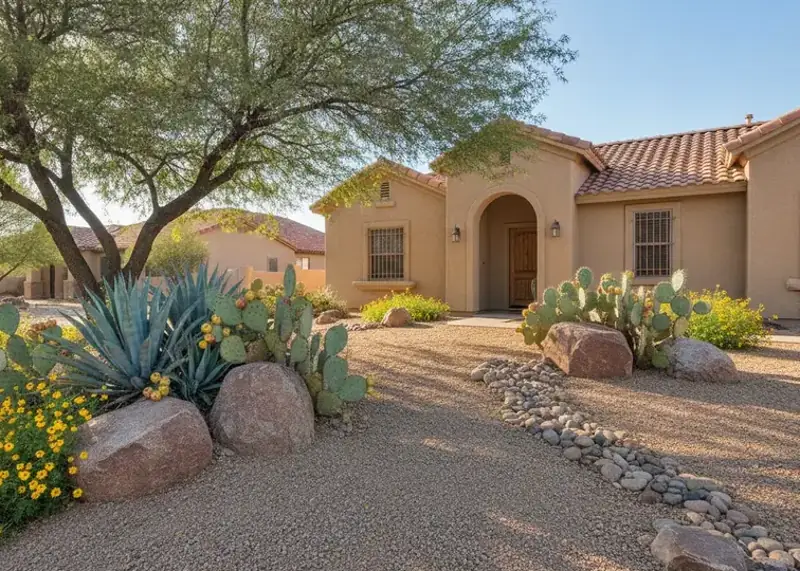
What the Arizona Native Plant Law protects
The law protects listed desert plants in several categories. According to University of Arizona Extension publication AZ1506, Arizona Native Plant Law: What You Need to Know, the main ones a Tucson homeowner will run into are:
- Highly Safeguarded: includes the saguaro.
- Salvage Assessed: palo verde, ironwood, mesquite, desert willow and smoke tree.
- Harvest Restricted: ironwood, mesquite, yucca and bear grass.
Some plants appear in more than one category. The point is that many of the trees and cacti in an ordinary Tucson front yard are on the list, which is why homeowners ask about it before a remodel.
The residential exemption, in plain terms
Section 3-904 sets out a general rule: a private landowner may destroy protected native plants on their own land, as long as the plants are not taken off the land or sold, and the landowner notifies the Department in advance. Subsection H then carves out homeowners. It says the section "does not apply to the destruction of protected native plants on individually owned residential property of ten acres or less where initial construction has already occurred."
For a typical Tucson house lot, that means:
- Taking out a palo verde that is crowding the driveway: no state notice under §3-904(H).
- Removing a mesquite that has outgrown the yard: no state notice.
- Removing a saguaro that is in the way of a project: no state notice, though saguaro removal is heavy, specialized work.
The exemption is about removal (destruction) on your own built lot. It does not change the rules for moving or selling.
When notice is required: larger or unbuilt land
If your land is more than 10 acres, or construction has not yet happened, the general rule applies. Section 3-904 requires the landowner to notify the Department ahead of time:
- 20 days ahead for land under 1 acre;
- 30 days ahead for 1 to 40 acres;
- 60 days ahead for 40 acres or more.
That matters if you are building on a vacant lot. The City of Tucson and Pima County also have their own native plant rules tied to grading and development permits; if you are building, ask your city or county planning office what applies.
Moving or selling a native plant needs a permit
Transplanting a saguaro to a friend's property, selling a mature ironwood to a nursery, or salvaging cacti off a lot all involve taking plants off the land. Under §3-904(F), that requires a permit and tags from the Arizona Department of Agriculture. If a company offers to buy or haul away a protected plant, ask how it handles permits and tags. Check with the Arizona Department of Agriculture before moving or selling any native plant.
Before you remove: pruning may solve the problem
Many removals start as a pruning problem: a mesquite that is top-heavy before the monsoon, or a palo verde hanging over the roof. University of Arizona's July gardening guide for Pima County recommends pruning mesquite and palo verde in summer, when they heal quickly in the heat, not sealing cuts, and never removing more than a quarter of the canopy at once. Thinning a top-heavy tree before storm season can reduce the risk of limbs coming down. Our guide to pruning mesquite and palo verde covers the details, and local companies offering tree trimming in Tucson can quote either option.
If you do remove a tree, Tucson Water's Rainwater Harvesting Rebate includes "Treebates" of $50 for a first and $49 for a second drought-tolerant tree, within a $1,999 program maximum. A Watershed Management Group workshop is required first, and funding is limited.
Hiring help for removal
We found no Arizona state license for tree trimming, and Arizona's gardener exemption covers routine "shrub and tree maintenance." For removal work, ask:
- Do you carry insurance, and can I see proof?
- Has anyone on the crew earned ISA certification (verify at isa-arbor.com)?
- How will you remove the roots or stump, and haul the debris?
- If the plant leaves my property, how will you handle Department of Agriculture permits and tags?
- If this is part of a larger landscape install of $1,000 or more, what is your ROC number?
Our article on hiring a landscaper in Arizona explains when the ROC rules apply. If you plan to replant, see desert landscaping in Tucson or set up ongoing desert landscape maintenance.
Replanting after a removal
If you replace a removed tree, plan for Tucson's soil. Caliche, a layer cemented by calcium carbonate that can run from a few inches to several feet thick, is common in southern Arizona and blocks roots and drainage, according to UA Extension's Managing Caliche in the Home Yard. That guide suggests digging a planting hole no deeper than the root ball and three to five times as wide, breaking through caliche where possible, and checking that water drops at least 4 inches in 4 hours. New trees need water every two to three days through their first summer, per UA Extension guidance on watering trees and shrubs.
What removal and trimming cost
Published cost guides put tree trimming in Tucson at about $112 for a small tree, $444 for a medium tree and $904 for a large one. Those are typical ranges from published cost guides (2026), estimates rather than quotes. Removal, saguaro work and hauling can run higher. See our Tucson landscaping prices page, then request free quotes. Tucson Lawn Care Pros is a free quote service; the company you choose quotes, contracts and does the work directly with you.